CASE STUDY #1 - Welder training bespoke packages
"Even major fabricators get it wrong sometimes!"
Background:
A major “welding-led” company approached Weld-Class-Solutions to establish the competence of their large number of coded welders. There were growing concerns over the continuing rise in rework and general doubts in the abilities and competence of the personnel involved in the fabrication and welding of safety critical products. Major health and safety issues were also a cause for concern.
How we helped:
By close contact with key personnel within the organisation, Weld-Class-Solutions were able to devise a plan with realistic timescales and provide initially, a Training Needs Analysis (TNA) of all personnel in order to find out the gaps in individuals technical and practical skills.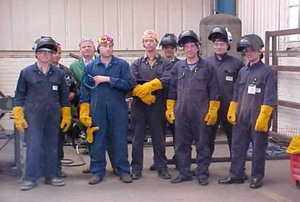
Each individual welder was assessed with the main emphasis on agreed competencies and from the information gathered; a training course and assessment programme was designed and implemented with the express objective of satisfying the seven outcomes below which were agreed with our client.
Welders needed to be able to:
- Correctly set-up welding equipment for the different applications used in production within the company.
- Correctly adjust and maintain welding equipment to ensure the consistent performance required for quality welding.
- Correctly interpret a welding procedure specification and be able to understand the content.
- Correctly identify welding imperfections and be able to understand their main causes and avoidance.
- Correctly assess a weld visually in relation to features and imperfections and apply a defined acceptance standard.
- Understand Health and Safety requirements related to welding and fabrication.
- To be able to pass welding tests to the requirements of BS EN ISO 9606 Pt 1.
Additionally, we addressed the following problems to achieve value-added benefits and overall cost reduction:
Problem 1: Uncontrolled use of welding consumables.
Solution 1: A reduction in cost of welding consumables was likely to be 50-70% which in real terms represents a saving of between £100-200K per annum for this company.
Problem 2: Before any training was given to the welders, the average welds produced during the initial training need assessments were commonly oversize.
Solution 2: By reducing weld size to that specified on the drawings and welding procedures, costs of welding wire and shielding gas consumption were potentially reduced overnight by around 80%
Problem 3: Before the training the welders were unable to read or understand the content of the welding procedures. The consequence of this was that the welding procedure specifications were not being followed and variable weld quality was evident.
Solution 3: Welders were given tutorials on the meaning of the WPS content and shown how to interpret the information on the job during the practical training part of the course.
Problem 4: Before our training courses, few welders could pass a welder qualification test mainly due to poor application by the third party inspectorate of the approval standard.
Solution 4: Weld Class-Solutions took over the service for welder qualification testing. Following training, most of the welders now legitimately pass the test(s)
Problem 5: Before the training, welders were unable to correctly set up the equipment.
Solution 5: Following training, welders are now able to confidently set-up their equipment and recognise when things go wrong. They are also able to carryout preventative maintenance tasks.
There were a number of additional potential knock-on benefits from the training including:
- Less distortion of the product and therefore less costly rework. Re work and repair in welding is commonly 10 times the cost of the initial production welding.
- Increased productivity. Less volume of weld metal deposited means greater efficiency and use of precious production time.
- Better design by increased actual throat thickness of the welds by increasing weld penetration can mean greater strength compared to larger welds which commonly have less penetration.
- Improved control of weld shape and reduced levels of imperfections, as welders knew the actual function of the welding parameters and could correctly identify weld imperfections.
- This meant less repairs of weld imperfections that are permitted within the acceptance standard and repairs of weld imperfections that are outside of the acceptance standard.
- Improved weld crater finishes at the weld stops and improved re-start of welding means better root penetration and smooth transitions.
- Better position and posture of welders when welding means less strain or injury, fewer risks from welding fume and better visibility of the weld pool means better weld quality.
- Some of the welding procedures were questionable due to human error in transposing details from WPQR’s to WPS’s. Weld-Class-Solutions were able to provide real guidance to the company welding engineers on a whole host of improvements to the current documents.
- A matrix of welder qualifications was also generated which provided valuable feedback information of the testing and retesting needs for the welders.
Read more about how we can improve welder competence in your organisation.
Do you wish to see what Weld-Class-Solutions can do for your business?
Contact us today on 01223 839682/Mobile +44 (0) 7790 163097